Showing posts with label Bollywood. Show all posts

Friday, January 2, 2015

HAPPY ENDING: Or Not


About ten minutes into Happy Ending, the new film from writer/director duo Raj Nidimoru and Krishna DK, I recalled with a pang my high expectations for and indifferent response to their last movie, Go Goa Gone, which also starred (and was produced by) Saif Ali Khan. Saif was funny in that one as a blond zombie-killer with a faux Russian accent. Overall, though, Go Goa Gone felt like a sketch that lasted much too long. Raj and DK’s earlier 99 and Shor in the City remain favorites of mine, films with heart and soul and danger as well as comic timing, so GGG’s sogginess was a particular disappointment.

I had forgotten all about Go Goa Gone until Happy Ending got into its introduction of Saif Ali Khan’s callow Yudi, who loves the ladies but is such a commitment-phobe that he alienates every girlfriend the moment she says “I love you.” A film about such a lad is not, shall we say, an especially fresh idea. Yudi, who narrates, breaks up with an adoring Kareena Kapoor and then launches into a rant about men being like dogs, of which there are apparently two types: lap dogs and street dogs. <counter-rant>This bogus two-typing irritates me first on behalf of dogs, many of whom are neither spoiled and overfed nor happy to be “free” to scavenge and suffer, and second on behalf of men and women everywhere, who are the same species, after all. I’m deeply tired of assumptions about what women want from men and how women’s wanting inevitably makes men miserable. GAAHHHHH</rant> Watching this, I suddenly remembered that weak film Raj and DK had made in the years since Shor in the City.

#HeforShe
The supporting actors in Happy Ending are players I’m almost always glad to see, so I wish that they hadn’t been given roles that further solidify the women-want-to-domesticate, men-want-to-be-free storyline. Kalki Koechlin is amusingly terrifying as a stalker-girlfriend-dentist who refuses to believe Yudi has broken up with her, but when she tries to manipulate Yudi into marriage by claiming she’s pregnant, my patience with the character became very thin. Preity Zinta has even less to work with as the motherly ex who is willing to put her own family life on hold in order to let Yudi cry on her shoulder for no apparent reason. Ranvir Shorey is a miserable cartoon of a best friend who acts as if his wife is keeping him on a leash and, when released for an evening, demonstrates that he needs further housebreaking.
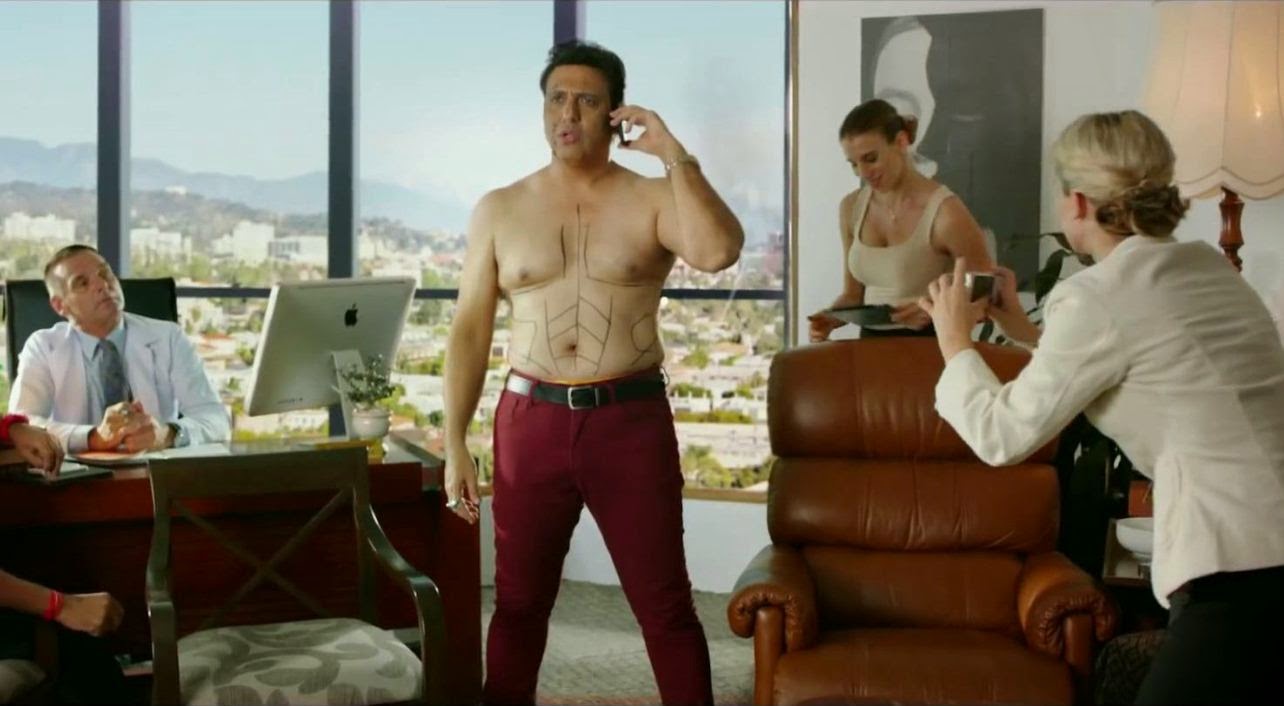
Happy Ending Govinda plastic surgery
Go Govinda Gone
But then there's Govinda. In a small role as over-the-top Bollywood star Armaan, who hires Yudi to multiplexify his single-screen career, Govinda has the time of his life. I am not likely soon to forget the scene in which Armaan ji takes simultaneous meetings with his writer and his plastic surgeon, parading around shirtless with the surgeon’s pre-op Sharpie marks all over his flabby torso and middle-aged face. Props to Govinda for his willingness just to be middle-aged on camera in spite of all the Salmans, Shahrukhs, and Aamirs who have made being forty-plus look so strenuous (even if there is a presumably CGI follow-up scene in which Armaan displays his far more chiseled post-surgical self).

Other small grace notes finally made this a more likable film than I expected after the disappointing start. Saif Ali Khan is loose and easy in a double role as buff Yudi and schlubby Yogi, who may be Yudi’s socially awkward twin or may be a manifestation of Yudi’s inner couch potato (I do wish the screenplay had made it clearer whether this was a real person or a figment of Yudi’s imagination). Leading lady Ileana D’Cruz, who seemed mostly waif-like in Barfi, where she had the misfortune to be cast as the non-disabled character admiring the leads’ enduring love from afar, here has a chance to show a bit of spark. She and Saif Ali Khan have chemistry in a goofy mutual seduction scene—and her character, Aanchal, isn’t nearly as drippy as the godawful prose she has to present at readings of her hit novel. (I know there’s a joke in there about how bad bestsellers can be, but why should her book bore even the people who come to her readings?) Aanchal is no romantic; she’s even more resistant to love than Yudi is, and unsurprisingly, he soon finds that he doesn’t want to live without her.

The ending for Yudi and Aanchal seems happy enough, but Yudi's voiceover points out that the key to a "happy ending" is simply stopping at the right place. There are no guarantees about what will happen afterward.  It's a weird, if potentially thoughtful, note to hit at the end of a romantic comedy.

The film’s meta-story, which purports to be Yudi’s Hollywood notes for Bollywood king Armaan, moves at a leisurely pace and vanishes altogether at regular intervals. Its meandering path only bothered me because I’m a great admirer of the tightly interwoven storylines of 99 and Shor in the City and of the way those two films adroitly mixed great comedy with cold fear. Both films offered happy endings that were not just upbeat, but immensely satisfying.* Happy Ending moves from hardcore cliché toward something more nuanced, but that move somehow makes the film feel as if it simply hasn’t decided on an ending at all.

Damn it, I want closure!

Heading for a happy ending
*I saw Raj and DK at the New York premiere of Shor in the City (then called simply Shor), and after the showing the mostly NRI audience gave the directors a grilling about the lack of “realism” in the ending. The filmmakers pointed out that happy endings are not inherently more unrealistic than unhappy ones. I can’t help wondering, though, if the films they’ve made since Shor have been affected by the festival-goers’ grumbling. Raj and DK, ignore New Yorkers, please! Except me, of course.


Monday, March 31, 2014

ANDAZ APNA APNA: Fun and Funner

Comedy stylings.
After several weeks during which an online course ate up all my free time and there was precious little Bollywooding, I am celebrating the (presumably imminent) arrival of SPRING here in the northeastern US by working my way through a box of comedy DVDs sent my way by the wonderful Supraja*!

First up: a film I tried to watch years ago and so did not get, Andaz Apna Apna. This film stars what today would be a deeply unlikely comedy duo, Salman Khan and Aamir Khan. Even in 2002, renting this from my local Indian grocery, I didn't quite see how Lagaan plus Hum Aapke Hain Kaun could equal anything remotely coherent.... And I ended up flummoxed and not very amused. (Others whose tastes I admire have had similar qualms, including the excellent Beth Loves Bollywood.)

But if Supraja says that this film is a favorite--and if dozens of other writers praise it as one of India's funniest comedies--then I must give it another go! So here's what I think after revisiting this film ten-plus years into Hindi film fandom.

Coherent? OK, it's still not very coherent, or at least not for a gori filmi-fan. And Andaz Apna Apna will probably never be considered great filmmaking by anyone, no matter how fondly fans recall it in the coming decades. (Continuity people, please note that  real hair does not become shorter, longer, and then shorter again over the course of a weekend.) But the good news is that if you're in the mood for something very silly, and if you have seen a lot of Hindi movies, or Sholay several times, then you'll probably be able to move this from the "Wha...?" column to the "Ha!" column. You just might need to watch this one.

We begin with Aamir, as Amar, cycling along in shorts, and aai la! running into stranded film heroine Juhi Chawla (who was Juliet to Aamir's Romeo in Qayamat Se Qayamat Tak). He rescues her and wins her heart, but even in this dream sequence Amar is a gold-digging layabout:

juhi chawla, aamir khan
How very modern he is not to insist on Juhi's giving up her film career after the wedding.
When Amar wakes up, he's revealed to be a good-for-nothing who steals money from his hardworking dad's barbershop so he can blow it (or "blow it up," as the subtitles say) on fancy haircuts.

Next we're introduced to Salman as Prem, who is swiping money from his father, a tailor, to pay off a swindler who pretends he has film-world connections and will make Prem a big star. This provides an excuse for a series of hilarious Salman headshots--this trio pretty much sums up his career so far (yet I find him ridiculously charming here).


Salman hero
I love Salman's game face!
Clearly, we've departed from the Romeo and Juliet Shakespeare plots and moved to the implausible wacky Shakespeare comedies, and Andaz Apna Apna plays to the groundlings. Amar and Prem both hear about Raveena, an heiress who has come to India from London in the hope of finding a nice Indian boy to marry. Both of our "heroes" sell their father's businesses and run off with Dad's money, hoping to marry the rich girl. Amar and Prem meet and discover the things they have in common (i.e., lying, laziness, and a desire to marry an heiress). They play some dirty tricks on each other before deciding to join forces to defeat the other thousand or so young men who are lining up to be Raveena's choice.

Raveena Tandon and Karisma Kapoor play Raveena and her secretary, Karisma, or possibly they play Karisma and her secretary, Raveena. (None of the main characters in this film are exactly who they say they are, so this confusion is par for the course.) 

Once the other suitors are dispatched, Amar finagles his way into the heroine's house by faking amnesia, and then Prem pretends to be a doctor who pretends to cure him. Salman in particular appears to be having the time of his life in this scene. He gets to slap and throttle Aamir and threaten him with an injection meant for horses. 
Karisma Kapoor, Raveena Tandon, Salman Khan, Aamir Khan
Salman wielding a mallet (and a mullet)
Salman's enthusiasm for Karisma's suggestion that the amnesiac be beaten on the head makes for the film's funniest scene. "WHY NOT?!?" he exclaims, in English, with unfeigned glee. If only Salman could work up as much interest in the roles he plays in this decade! 

Karisma wears some of the most hideous outfits you'll ever see on anyone, which is saying a LOT for a 1994 Bollywood film. (The pictured ensemble--pants that appear from the front to be fringed white Daisy Dukes with suspenders but from the back look like leggings--ought to serve as a cautionary tale to adventurous young designers everywhere.)

In due time the boys' identity is more or less revealed, not that anyone cares. The couples pair off, and the girls explain that Karisma is Raveena and vice versa, which is problematic for a couple of minutes and then falls by the wayside to make room for bigger identity issues. Raveena/Karisma's rich industrialist daddy (Paresh Rawal) has an evil twin who decides to kill the daughter to get back at his brother, or something. The servants in the Raveena/Karisma house, Bhalla and Robert, are secretly in the villain's employ and try to do the poor heiress in using a bomb, a poisoned drink, and Vasco da Gama's gun. All of this works exactly as well as it does when Elmer Fudd tries to kill Bugs Bunny. Let it wash over you in the Warner Brothers spirit and/or have a few drinks while viewing, and you'll find yourself giggling like an idiot.

Two simultaneous kidnapping plots, a diamond heist, and dacoity from a villain who calls himself "Crime Master Gogo" occupy much of the second act, which brings all the characters--including both Paresh Rawals--together for a final showdown. And since it's a godown showdown**, the room is filled with barrels and henchmen. One Paresh Rawal's cheek is marked with an X. But is he the good Paresh Rawal or the bad one? 

The good guys (using the term loosely) and the cartoon villains take turns having the upper hand. At one point Gogo and Prem have what appears to be a pelvic-thrust-off:


Crime Master Gogo, Salman Khan

There's no physical contact, but the sheer force of their masculinity knocks them over anyway. Fortunately, nobody gets hurt.

It will come as no surprise that all is well in the end. Everything turns out so well, in fact, that Paresh Rawal (the good one) apparently forgets that Karisma (or is it Raveena?) is merely his daughter's secretary instead of his actual daughter, and everyone acts as if both Amar and Prem are about to become lucky rich husbands of two women who now are apparently both heiresses. What a relief for Amar, who was resigned to marrying the penniless one!

And speaking of families--astonishingly, we never return to the badly dissed fathers of the opening sequences, last seen being put out of their houses. Paresh Rawal is apparently daddy enough for everyone! Pretty soon, he will get to play three father-figures in Oye Lucky! Lucky Oye!, so I guess this is good practice.

Paresh Rawal

Aai la! Oooee ma! Elmer Fudd and Bhalla! A good time is had by all, even by the bad guys whose bombs and guns always backfire. Live-action cartoons can be pretty hilarious. 

*who is AWESOME!! Thank you, Supraja!!

**I have always wanted to say that. 

Sunday, July 7, 2013

YEH JAWAANI HAI DEEWANI: Energizer Bunny


Once the basic needs of life are taken care of, what makes a person happy? Yeh Jawaani Hai Deewani tackles that question, sort of, but if you ask me, the film is arguing for giant Bollywood production numbers as one of life's great pleasures. And since really good naach-gaana strikes me as a prime reason to be cheerful, you will get no argument from me on that.

Watching the first number in YJHD, which happens right at the beginning of the film, I realized how very long it has been since I've watched a song-and-dance extravaganza that was this much fun. I've heard the argument that it's a comedown for the great Madhuri Dixit to appear as a tawaif in an item number, but I'm just grateful to see her dance again. Her beauty is all the more poignant now that her face has a few lines, and the spring in her step seems undiminished. And what joy there is in her dance-off with Ranbir Kapoor! The situation requiring the dance remains vague to me (he's an intern on a documentary shoot, she's the subject of the film, and there seems to be a lot of innuendo), but as the kids say, whatever. It's the kind of dance number that makes me glad to be alive and reminds me of the wonders of unapologetic Bollywood. I grinned like an idiot all the way through.


And if there is a future for Bollywood as we have known it in this age of the Hindi indie (and I love both)--Ranbir Kapoor is the one I would pin my hopes on. Watching him dance is one of the reliable pleasures of today's cinema, and if the merest excuse is all it takes to get him started, well, hooray! Even when he isn't dancing--even when, as in this film, his character seems a hair underwritten--I'm willing to go along. A not-very-studious young Indian citizen gets a full scholarship to Northwestern with so little effort that his friends don't even know he's applied? A journalism degree leads to a job as a globe-trotting cameraman (the kind who breezes through Rome at sunset, not the kind who gets shot at in Afghanistan)? The cameraman job leads to an offer to be the host of a reality show that involves living in Paris for six months, apparently minus the Real World-style psychotic roommates? OK, fine, let's not look too closely. If anyone on earth has that kind of luck, why not Ranbir Kapoor?

Deepika Padukone
What "plain" looks like in the movies.
The foil to Ranbir's Bunny is Deepika Padukone's Naina, a glasses-wearing girl who spent her formative years studying so hard that her schoolmates didn't even register her presence. (Let us pass lightly over the Hollywood/Bollywood convention that if a girl wears glasses, then she cannot be considered attractive, even if she has a face like Deepika Padukone's.) Now she's preparing to be a doctor, but a chance encounter with a free-spirited former classmate (Kalki Koechlin) makes her decide on a whim to go spontaneously trekking in Manali. Naina and Bunny--also old schoolmates--meet cute shortly before the trip, which starts with an unexpectedly poignant drinking game in a crowded train compartment that reveals good-girl Naina as the odd one out among her more flirty, flighty young companions.

Olivia Newton-John in Grease, changing yourself for a boy
What I was afraid of.
My daughter, who has experienced just under 14 years of life, pronounced this film "predictable," but based on my longer time on earth I'm convinced it was not at all a given that Naina would fall for Bunny without actually losing herself in the process (think of what Olivia Newton-John went through in Grease to get the boy). While the spontaneous Manali trip may seem out of character for careful planner Naina, she proves there that she has a sense of adventure and plenty of good humor. She also falls for good-time loverboy Bunny, but just as she's about to tell him how she feels, she learns about his sudden serious Northwestern plan, which a studious girl like Naina wouldn't think of derailing. Instead, she decides to forget him and buckles back down to her chosen career path.

We catch up with Naina and Bunny again after the interval, when they're eight years older. The occasion for the old friends' reunion is the wedding of Kalki Koechlin's character, who is engaged to marry not Avi (Aditya Roy Kapoor), the fourth old trekking pal on whom Kalki once had a crush and who has become something of a loser, but the wacky, plump Kunaal Roy Kapoor (last seen by me having some serious intestinal distress in Delhi Belly, and, for what it's worth, the brother of Aditya). I expected, then worried, that Kalki would ditch her bumbling but sweet fiance for her old flame, but fortunately, YJHD doesn't take that path either. The four friends get to know one another again. Bunny has soared, while Avi has also tried to make a living having fun and failed. Kalki has found a dependable, traditional guy and discovered that she likes being solid and respectable; Naina, who has always been respectable, has remained alone and seems OK with that choice.

The wedding/reunion is the occasion for yet another showstopping number from Ranbir*, and I throw it in here because who doesn't need the occasional delirious good time?


I'm not going to say that it's a spoiler to mention that Bunny and Naina do eventually end up together, but for a good part of the film, that outcome doesn't feel certain. How nice, at least, to see these two not making any decisions about pairing off until after a conversation acknowledging that they want different things from life. Bunny raves about the famous burgers of San Francisco (burgers?? but never mind), while Naina extols a home-cooked biryani. In the end, Bunny is pulled earthward, in traditional Hindi-film fashion, by realizing that being at home more would have given him more time with his big-hearted and doting father (Farooque Shaikh, awwww). His teasing, sweet relationship with dad and stepmother (Tanvi Azmi, also adorable) makes the belated attractions of family life a little more believable.

In the end, it feels pretty satisfying for Bunny to come to Naina and not the other way around. They may not have worked out all the problems that they'll have to resolve, but at least they're thinking things through. And so, after the film, was my daughter, who wisely noted, "He can travel, and then come home. Or maybe she can travel with him once in a while."

And then while they're in the same place, they can do a lot of big fluffy Bollywood production numbers. And that, my friends, sounds like more than enough for a happily-ever-after.

*Am I imagining this, or does someone really shout "Ranbir!!" when he shows up at the beginning of this video?

Wednesday, May 22, 2013

DABANGG 2: Kiss Kiss Dabangg Dabangg


After watching the first half of Dabangg 1, I felt I had pretty much gotten the gist, so I never finished it. The opening of Dabangg 2, with Salman Khan's Chulbul Pandey wreaking havoc in the villains' lair, gave me a sense of déjà vu that was almost overwhelming. The one thing I didn't expect from this movie was surprises. Nevertheless, Dabangg 2 did produce a couple of raised eyebrows.

The first surprise was the ethical shortcomings of pretty much everything Chulbul did. At the risk of sounding like a scold (main maan hoon!! cut me some slack!), why is Chulbul taking his younger brother to hang with bar girls to celebrate the brother's new job with the police force? It's true that the result is a kind of fun item number featuring a wriggling Kareena Kapoor splashing booze all over the room in Bollywood shorthand for "everyone is really drunk now."


But is this really the message Young India should be getting about the role of the police in a democratic society? Sigh. (Also, I'm guessing that the brother's wife, who is off studying to be a teacher so she can support the family, would not feel all that thrilled about her husband's new job if this is how it makes him behave.)

While we're on the topic of questionable cop ethics, I note in passing that most of Chulbul's heroics culminate in his acquisition of piles of money, whether it's a gangster's squirreled-away stash or a suitcase full of rupees that a father has brought to ransom his little boy. I don't care how conniving the businessman father has been--making him hand the ransom over to the police instead of to the thugs kind of blurs the line between them, don't you see, Chulbul? If you're a cop, you don't get to play Robin Hood. You're already supposed to be one of the good guys.

Salman in Dabangg 2, or
close approximation.
The other, equally unpleasant surprise was that the movie was just plain boring. How nice for the Khan brothers that they've gotten their hands on that Matrix camera that allows the audience to see slow-mo projectiles whizzing over Salman's torso or to see Salman kicking in a series of villains' faces 1! 2! 3! 4! while whirling in midair like a pole dancer. But I never expected a movie to make me say, "Ho hum, Salman has dodged a flying machete with a yogic back bend yet again." And that's what this one did.

The dances are all the same. Salman does the belt-buckle wiggle and some suggestive hand motions. He's always dancing in front of a phalanx of men (let's call them "Salmanellas") who look touchingly eager to be backing him as he does his musclebound moves.
Dabangg 2, Salman Khan
Salmanellas

But while dull choreography is pretty bad, the really unforgivable boringness happens in the final scene. We've already noted that Chulbul's fighting technique is unstoppable: he can mow down a lairful of evildoers without breaking a sweat. He encourages little children to sit and watch his dhishoom-dhishoom because there's so little chance of anything going wrong. I'm no screenwriter, but I do know that in order to give us a little suspense, the climax of the film must therefore supply some reason, however threadbare, for Chulbul to be not quite at the top of his game. Superman has trouble with kryptonite. Marty McFly has trouble with being called "chicken." But Chulbul has no apparent weakness. So, out of the blue, a couple of goondas get in a solid blow to our hero's face (this allows the Matrix camera to slow-mo the single drop of blood that drips photogenically from Salman's brow). Chulbul falls down (???); the chief bad guy walks off gloating; Chulbul gets up again and mows down the rest of the gang. And really, when the chief bad guy is a middle-aged politician, what other outcome could be possible when he's the last man standing against a shirtless Salman?

So it comes to pass that "Kung Fu Pandey*" beats the dumpy villain to a pulp when he should have been thrashing the screenwriter instead. Then the evildoer is handcuffed, after which Chulbul shoots him dead and swaggers off righteously.

You'll probably see all of this again in Dabangg 3.

*The only funny joke in the movie.

Saturday, May 4, 2013

LUV SHUV TEY CHICKEN KHURANA: You Can Go Home Again

Kunal Kapoor, Huma Qureishi
Luv & Chickens
Moments after the first appearance of a lovely young woman who clearly has a history with the handsome hero of Luv Shuv Tey Chicken Khurana, she storms off, and he tries to summon her by whistling “Tujhe Dekha To,” a tune that has become shorthand for a certain kind of romance involving young Indians abroad and the lure of an ancestral Punjabi home. The theme song worked famously for Shahrukh Khan in the original Dilwale Dulhania Le Jayenge; plucking those notes brought Kajol running at dawn through the yellow mustard fields to find her NRI darling. Here, though, Harman (Huma Qureshi) does not even turn to take a look back at Omi Khurana (Kunal Kapoor), who ditched her to run away to England a dozen years earlier. She just keeps riding her scooter into the night.

First-time director Sameer Sharma makes just this one explicit reference to DDLJ, meeting what I presume is the minimum legal requirement for films set in Punjab. But by setting this story in a world in which DDLJ exists, he can use what we think we already know about this story to take the tale in a different direction.

Kunal Kapoor, Luv Shuv Tey Chicken Khurana, nightclub Hell
Omi in Hell
Like many films that contrast the wicked West with postcard-perfect India, Luv Shuv starts in London, so we see iconic shots of Big Ben and other touristy locations; I half-expected the late Amrish Puri to be in the background feeding pigeons. Omi is at a nightclub called “Hell”—I imagine Simran's father nodding grimly at that, too—surrounded by blonde British babes (played by blonde Russian babes) and Chinese guys who speak very dubbed-sounding English small talk. I waited for Omi to play some dirty trick on the Chinese gentlemen, but in the first of the small, enjoyable expectation-reversals that Sharma perpetrates throughout the film, Omi instead steals money from the purse of one of the girls—and then impresses her by paying for her drink. Yes, Omi is thoroughly a scoundrel.

Then a Punjabi heavy shows up and demands that Omi repay him many thousands of pounds, to which Omi responds by scarpering off to Punjab, that yellow-flowered agricultural paradise known to every Hindi-film fan. There, Omi assures the heavy, his family runs a famous eatery and will certainly give him the money.

Omi's home region is as postcard-pretty as it appears in DDLJ, but sly references, such as a painted-clay “Jatt Airways” model plane instead of a revenue-generating shot of an actual jet, suggest that Sharma enjoys reminding us that we're in a fantasy land. But it's certainly not Omi's fantasy to be there--his dream was to be a big shot in London, and he is neither happy to be home nor confident he's heading into a big welcome.

And uh-oh, flashbacks reveal that Omi left after chloroforming and robbing his grandfather, Darji. (Don't try this at home, kids! Generally, that's not the kind of memory you want the folks back home to be cherishing if you expect them to be happy to see you. Remember how long it took Amrish Puri to forgive Shahrukh Khan for even the minor crime of trying to buy beer after hours?) Omi's tentative approach to the family home reminded me of the scene in Bachna Ae Haseeno when another scoundrel, played by Ranbir Kapoor, arrives in Punjab to apologize for breaking the heart of a DDLJ-obsessed girl on a Swiss holiday years before. Surely it's poetic justice that Kunal Kapoor, who in that film answered the door and meted out beatings*, is the one slinking home again here.


As it happens, Omi doesn't have to face a reckoning with Darji, who has Alzheimer's and can't remember a thing—not even the recipe for Chicken Khurana, which means that the “famous eatery” is shuttered and the family broke. Omi's aunt and uncle, who raised him, are pleased to see him, though the uncle remains justifiably wary. Cousin Jeet (Rahul Bhagga) seems genuinely delighted at the wanderer's return in spite of the fact that Omi blinded him in one eye in a shooting accident years earlier. Titu Mama, the uncle who may or may not be crazy, is the only openly hostile member of the household.
Kunal Kapoor, Rahul Bhagga
The prodigal returns

Omi quickly proves that his powers of empathy aren't aroused by the lack of a family fortune to wheedle or embezzle. In one hilarious bit, he snoops in Jeet's office safe, accidentally setting off the music and flashing lights of the small battery-operated deity stored inside. It's not cleverness or trickery that keeps his relatives from finding out how little the prodigal cares about their welfare; it's sheer luck. But Harman, the girl Omi abandoned for London and has not called once in the dozen years he's been gone, is onto him. Harman is now engaged to Jeet. Both of them seem indifferent to the impending wedding, but she's still in no mood to forgive Omi for ditching her. When Harman is asked to change the bandage on Omi's bloodied nose (she's a doctor now), she glares straight into his eyes while ripping the dressing off his wound as brutally as possible. (Huma Qureshi is totally believable when making men weep—here she is chastising Nawazuddin Siddiqui for daring to hold her hand in Gangs of Wasseypur.)

Huma Qureshi, aviator glasses
Don't mess with Huma Qureshi.
Like Kajol's Simran in DDLJ, whose engagement to a Punjabi lout is merely an obstacle for True Love to overcome, Harman will of course not end up married to Jeet. The overall arc of the romance and family reconciliation in Luv Shuv will come as no great surprise to anyone who has seen a typical Indian (or, for that matter, Hollwood) film: Harman and Omi will rekindle their teenaged romance; Omi will see the error of his ways and be welcomed back to the fold. The quirky family members may prove more tolerant than is perhaps realistic, but I am a sucker for any scene featuring an elderly aunty ji announcing,“We're old, but we're not old-fashioned," whether or not I think it would happen in real life.

And what about those gangsters—the plot device that has sent both film and Omi back to Punjab, where their seemingly cynical hearts still lie? At first, the bad guys make solving the culinary mystery a matter of some urgency for Omi (and they also providing a rationale for the plotline that earned Luv Shuv its billing as "India's first food movie"), but Omi's search for the secret Chicken Khurana recipe gradually becomes more quixotic and relaxed before heading off in an unexpected direction. Finally, the movie finds its Punjabi groove and lets go of any suggestion that anything terrible might be about to happen. There is a final confrontation, but nobody else gets shot or beaten**.

This is a far sweeter film than DDLJ to me, since it omits all the irritating which-man-gets-to-own-Kajol macho posturing; and it's funnier, since the jokes are often at the expense of people who need to be taken down a peg instead of at the expense of a very sheltered young woman. But I'd argue that it's more romantic, too. Perhaps it's because the love stories here are, like me, a little more wearied and worn—from the torch Darji still carries for his late wife when he can remember nothing else, to the rekindled old flame between Omi as he starts to wise up and Harman as she starts to thaw, and finally to the moment when Darji recognizes Omi and speaks of how he's missed his prodigal grandson. Punjab ends up being home for Omi because it meets Robert Frost's definition: the place where, when you have to go there, they have to take you in.

And all of this plus another great score by one of my two favorite current music directors, Amit Trivedi. Maybe the song below isn't quite as ringtone-friendly as "Tujhe Dekha To," but I can vouch for both its awesomeness and for its power as an earworm:


Happy 100 years of Indian cinema!! I like the direction things are going at the moment.

*By this point in Luv Shuv, Omi has already endured the only beating he'll get in the film; personally, I appreciate getting this out of the way early on. I know, but do not understand why, many audiences in India in the 1990s loved to see a last-reel pummeling of Shahrukh, by the end of which he was invariably weeping and stammering, covered with blood and snot, but still standing and thus apparently worthy of getting the girl. Feel free to leave comments explaining this phenomenon to me.

**As Beth Loves Bollywood says, "You know exactly what will happen. You never know what might happen." Exactly. 


Monday, October 15, 2012

BARFI: Good Taste


Ranbir in Raj Kapoor mode.
India’s 2012 nominee for the foreign-language Oscars is Barfi, a sweet film starring the charisma-oozing Ranbir Kapoor as a deaf Darjeeling boy. If Ranbir weren’t already a great big movie star, this performance would make him one—he’s graceful and charming, selling comedy and schmaltz with equal panache. Like every Hindi-film fan, I could list star kids at whom producers should stop throwing money, but in Ranbir’s case I’d argue that the genetic slot machine handed him a jackpot (which isn’t to say that he doesn’t put any effort into his roles—only that his effort is usually invisible from the audience’s perspective).

After seeing Barfi at a New York theater recently, I was surprised to learn that the buzz among Indian Oscar-watchers was all about the film’s supposed lack of originality. OK, I thought—maybe the nominating committee picked Barfi in a cynical attempt to piggyback off the success of The Artist, another film with a nearly silent leading man and a lot of nods to plot points and visuals from the pre-talkie era. Remember this?


(In which case, I hereby predict, it was a bad move; there’s no point whatsoever in second-guessing this year’s Oscar winners based on last year’s. But I digress.)

As it turns out, no, The Artist isn't the problem. Instead, as a quick click on some Wikipedia links reveals, Barfi is being charged with stealing ideas from a host of other films, from Charlie Chaplin and Buster Keaton silents to South Indian and Korean films of recent vintage. And the Internets are abuzz with concerns from Indians and NRIs that this kind of “cutting and pasting” (or theft, as the less polite would have it) will make Indian film a laughingstock in the international film world.

Now, Indian cinema has had a history of “unacknowledged remakes” in which hits from other cultures (often Hollywood) are recreated—character for character, plot for plot, sometimes word for word—without any “based on a story by” or writer credit to the original film. (Here, for example, is an unacknowledged remake, starring Oscar producer Aamir Khan, of this Cary Grant and Deborah Kerr starrer, and by the way, I loved both films.) And perhaps that history is what’s driving the almost unhinged anxiety among so many in the Indian media about whether Barfi is “original” or not.

But I have seen no evidence at all that Barfi has borrowed or repurposed material from other films on a scale bigger than what is typical in American cinema. Yes, Ranbir recreates Donald O’Connor’s dummy schtick from Singin’ in the Rain’s “Make ‘Em Laugh” number nearly move for move.


But what is he trying to do? Well, the autistic girl he loves, Jhilmil (a very un-glam Priyanka Chopra), is upset, so duh, he’s trying to make her laugh. I don’t know how popular Singin’ in the Rain is in India, but American audiences know it so well that I assumed the reference was purposeful, and it worked beautifully for me.

Raj Kapoor in Raj Kapoor mode.
And I also assumed that Indian audiences would enjoy, as I did, the sight of Ranbir channeling the great Raj Kapoor, whose beloved tramp character was “Chaplinesque” but firmly situated in Indian stories and films. Wearing a pencil moustache through much of the film, Ranbir looks remarkably like a fit, younger version of his grandpa. (Were filmgoers in the 1950s jumping on Raj for borrowing too heavily from Chaplin? If they were, Raj’s legacy is having the last laugh.)

Saurabh and Ranbir?
Yes, Barfi includes moves you’ll recognize from Buster Keaton and Charlie Chaplin, with chases that involve teetering ladders and runaway handcarts. The interaction between Barfi, turning to robbery in desperation to pay for his father’s operation, and his fat-cop nemesis (Saurabh Shukla, one of those undersung second fiddles whose solid performances anchor so many Hindi films) is reminiscent of Laurel and Hardy, or the Keystone Kops—practically any silent featuring an underdog accidentally provoking a foul-tempered authority figure, which is, let’s face it, a lot of movies.

Harold Lloyd goes to Korea?
There’s also talk of a sequence supposedly stolen from the Korean film Lovers’ Concerto (of which I’ve never heard, but who knows, maybe it did blockbuster business in India). A boy who has come on strong to a pair of girls in a restaurant realizes that he shouldn’t have and tries to “turn back time” and start the friendship anew. In the Korean film, the boy shows up outside the restaurant holding a clock. Barfi scales a clock tower precariously and swings the hand back. If you ask me, director Anurag Basu was inspired less by Korea than by Harold Lloyd’s iconic scene from Safety Last, but hey, I guess I’m not really that much of a stickler for originality. Whatever that means.

I really do wish that Indians wouldn’t get vocally outraged about the kind of "plagiarism" that is really a non-issue, if only because it reduces the chances of commercial Indian films being taken seriously abroad. (And yes, there are commercial Indian films that deserve to be taken seriously.) But sadly, I agree that Barfi—which is a very good and hugely enjoyable film—doesn’t stand much of a chance of getting into the foreign-film Oscar Top 5. Why? Well, in the U.S.A., “barf” (rhymes with “scarf”) means “vomit.” And that, not the silent-film references, is what Americans will find hard to swallow.

Charming, not barfy. 


Friday, July 27, 2012

SHOLAY: Endings

Sholay, Amitabh Bachchan
I hadn’t seen Sholay for about three years when a group of us watched it again last Saturday night. In 2009, I watched with a slightly skeptical audience who seemed to expect India’s most famous film to solidify their impression of Bollywood (“It’s very long, isn’t it?” was the most repeated comment). And I was ready for a few draggy bits on this re-viewing.

But there really aren’t many (well, apart from the jailer scenes—and there I may have been influenced by an even earlier showing during which my Ohioan father-in-law just couldn’t handle a side of over-the-top comedy with his brutal western). From the horseback bandits’ attack on the train to the massacre of the Thakur’s family, from Jai and Veeru’s bravado to Gabbar’s “kitne admi” scene, from Basanti’s blither to Radha’s silence, everything about this film—the story, the characters, the landscape, the actors, the angles, the stunts, the songs—seems to have been touched by genius. By the end my emotions had undergone some serious dhishoom-dhishoom.

So how did it end?

Sanjeev Kumar, Sholay
PTSD Thakur Baldev Singh
For several years I’ve always chosen the Sippys’ original ending, the one the censors didn’t want audiences to see, in which the armless Thakur kills Gabbar after whupping him mercilessly with those iron-spiked shoes. But after re-watching the censor-imposed ending, I was moved by the police officer’s appeal to the Thakur’s reputation as an honorable cop. I appreciated the film’s call to look beyond our collective lust for vengeance, to acknowledge the Thakur’s loss without approving his taking the law into his own hands sidestepping of the law. How refreshing to think that doing the right thing might mean not doing what Gabbar himself would do if, uh, the shoe were on the other foot. I think I'll stick with this ending from now on.

And for my oldest friend, Brenda, who died this week after a terrible illness, here's "Yeh Dosti." I'm pretty sure she never stole a motorcycle--but knowing her made my life much richer anyway. 


Friday, July 13, 2012

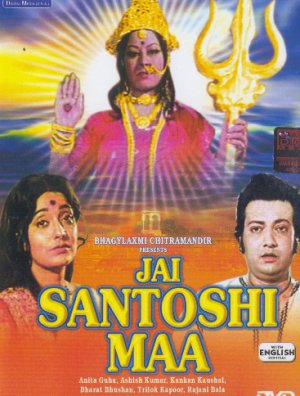
JAI SANTOSHI MAA: Satisfaction


Jai Santoshi Maa
Box art: These are the keeper stills?
You don’t have to be a believer to fall for Jai Santoshi Maa, the low-budget mythological epic that held its own at the box office in 1975 during the reign of Sholay. Anyone who has ever felt like a persecuted underdog can relate to the story. Trapped in a house full of spiteful relations who treat you like a servant? Well, perhaps some personal attention from a magical beyond can convince you that life is pretty good after all. It worked for Harry Potter.

Of course, Harry has tangible evidence of that magical beyond starting at the age of eleven. But Satyawati, our heroine and the true believer of Jai Santoshi Maa, has nothing but her unshakeable faith that the goddess Santoshi will solve her problems if Satyawati worships with sufficient devotion.

You can probably see where this is going. Obviously, in order for Santoshi to reward Satyawati in the most satisfying possible manner, Satyawati must first suffer the slings and arrows of outrageous fortune—the more outrageous the better.

Jai Santoshi Maa takes place simultaneously in heaven among the Hindu gods and on earth in a timeless, filmi version of India. In heaven, Santoshi is the wished-for sister conjured up by Ganesha’s sons; on earth, the motherless Satyawati (Kanan Kaushal) ardently worships the goddess. First Satyawati wishes for a husband, and she falls for the handsome flute-playing Birju (Ashish Kumar) when she meets him once in passing. When he is summoned to play and sing at a temple ceremony honoring Santoshi, she sees that Birju is truly the man for her.


He admires her from afar. But on the way home from the ceremony, Satyawati is jumped by a dreadful dacoit and his leering gang (in a very creepy scene that drives home what life must be like for many a rural Indian girl whose back isn't being omnisciently watched). Birju saves her in the nick of time, and then it’s clear to both of them that they have already spent many lifetimes together.

Bela Bose, Jai Santoshi Maa
Bela Bose is up to something.
In short order Satyawati and Birju are married. Obviously, all can’t continue to go smoothly—if it did, would there be a movie? The troubles come when the other sisters-in-law begin to dump all over both Birju (who wants to play music, not work in the fields) and Satyawati. The leading evil bhabhi is played by the addictively enjoyable Bela Bose, a dancer with a fabulously expressive face who does one of the best sneer-hmmph! combinations I’ve ever seen. (And apparently she had a long career, hooray! Perhaps there is a god after all….) The women laugh at Birju! They want him to earn a living! They feed him… gasp… leftovers!

leftovers, Ashish Kumar, Jai Santoshi Maa
Meanwhile, in heaven, the Big Three goddesses Laxmi, Durga, and Brahmini become jealous of the attention Santoshi is getting from Satyawati. They determine to make Satyawati’s life perfectly miserable and force her to renounce her devotion to Santoshi. To that end, the goddesses ensure that the sisters-in-law drive Birju out of the house (by means of the aforementioned leftovers, which suggests that I’ve been shockingly insulted over and over again since childhood without knowing it), then raise a storm that nearly drowns him as he travels around looking for work, then give him amnesia so that he forgets Satyawati—waiting patiently at home enduring terrible abuse and poverty—and starts to fall for another woman.

You’d think that Santoshi might take up arms against Satywati’s sea of troubles somewhat earlier in the game since the goddess is herself the object of jealousy and derision in heaven. It’s as if the devi and her devotee were new girls in parallel high schools populated by mean girls, and we wait—as in life—for the cruel ones to get their richly deserved comeuppance. But the goddess bides her time, and so things go from bad to worse for her loyal follower. Finally, Satyawati, whose long fasts have given her raccoon eyes like an Edward Gorey flapper, is so downtrodden that she can’t even buy the grams and jaggery necessary for her final Santoshi puja. Santoshi comes to earth in the guise of an old woman (clang! go the cymbals as she is edited abruptly into the scene) and presents weeping, starving Satyawati with the offering.

The film isn’t finished with us yet, even though Birju returns (now rich, having learned the jeweler’s trade and apparently forgotten his wish to be a musician) and Satyawati becomes the luxuriously dressed wife of a prosperous independent household. The mean-goddess triumvirate and the odious bhabhis—now jealous of Satyawati’s good fortune, because it’s always something—are still hoping to get the last word. They get their chance when Satyawati invites everyone to a big celebration in honor of Santoshi. (Check out Bela Bose here, pretending she’s joining in wholeheartedly—but noooo!)


Bela Bose and her henchwoman sneak off and squeeze limes into the food (a no-no for a Santoshi puja, apparently), which causes all the children eating at the festival to drop dead (!!!). The families blame Satyawati—her anger at her mistreatment, they claim, caused her to poison the children of her former tormentors—and things look blacker than ever before in Satyawati’s gloomy life until FINALLY Santoshi puts in a personal appearance, resurrects the dead kids, makes the guilty bhabhis confess, and sets the throng of onlookers cheering her power and her devotee’s spotless perfection. In heaven, the mean goddesses apologize for their misdeeds. All is again right with the world.

Jai Santoshi Maa, It's a Wonderful Life, Jimmy Stewart
Can't get no satisfaction.
How appropriate that Santoshi means “satisfaction.” My goodness, who wouldn’t find it satisfying to see physical proof of the deity’s existence and the smiting of a bunch of baddies all rolled up in one? As when Clarence the bumbling angel saves George Bailey* from his Christmas Eve plunge into the river in Bedford Falls, we root for the heavens to pay attention and the good to be rewarded, however unlikely the prospect seems in the face of so much opposition. Hello, you beautiful old Savings and Loan! Goodbye, Potterville! (Not you, Harry. Different Mr. Potter.)

It’s said that Santoshi was but a minor goddess before this film stormed the box office, but fans (many of them women who presumably found that this story spoke to them in ways that Sholay and Deewaar didn’t) treated the theaters as temples and bowed before the onscreen goddess, which was enough to move her to a more important place in the pantheon. I love when religion bends to the will of humans instead of the other way around.


As Real as the Velveteen Rabbit.
*Or if we’re definitely talking magic and not religion, we might note similarities with another great Jimmy Stewart movie, in which we are exceedingly gratified to learn that Ellwood P. Dowd isn’t just imagining that an invisible giant rabbit has chosen to be his friend. Harvey or Hagrid, Clarence Odbody or Santoshi Maa—I don’t have to believe any of them are real for them to bring me great joy and satisfaction. Ahhh.


Friday, June 29, 2012

LAALCHEE: The Rich Are Different from You and Me


Pran, Laalchee, Lalchee, Rohit RoyLaalchee (“greed”) sounds like a fable. If you search for “laalchee” on Google, as I did, you’ll come up with YouTube videos for this film, and also for several versions of the Aesop-ish Hindi story “Laalchee Kutta” (“The Greedy Dog”). So I was expecting, if not in-depth characterizations, then at least moral clarity.

So who can tell me the moral of this story? Anyone? Anyone?

Is it that being rich means that you can be any damn thing you please, including a leering old lech or a puppetmaster who makes the less wealthy dance for your amusement?

Is it that excesses of money make you treat women like personal playthings, even if they’re not interested in you?

Is it that being rich means that people assume you know what you're doing?

Pran's haveli,
or a reasonable approximation thereof.
Pran is Dinanath, a wheelchair-bound business tycoon living in one of those havelis with an entrance that resembles the driveway at Embassy Suites.

His four younger brothers and four sisters-in-law come to care for the ailing kazillionaire, but he pines for his missing nephew Amar, whose father—another brother—went off in a huff fifteen years earlier, apparently because he didn’t approve of Pran’s shenanigans with the ladies. The brothers and bhabhis surround the lonely invalid with chatter and children, planning picnics and doing what seems like a pretty good job of filling his empty mansion and life. Then along comes the sexy Kamini, a nurse much given to halter tops and short skirts (well is she nicknamed “Mini”). And seeing that she’s sleeping in his room,  that he’s spending ungodly amounts of dough on clothes that consist of little actual cloth, and that he’s dropping broad hints about marriage, the family members begin to worry about whether there will be any inheritance left for them.

Can you really blame them? You don’t have to be motivated by greed to think that perhaps your older brother has…slipped a bit when he’s spending all his time and money on a permed bimbo who pouts and coos and does the sexy-dance [1990s Bollywood version] in the old man’s room at night while the younger brothers spy through the window.


It’s just not dignified. I don’t know what I would do if my big brother began to behave this way*, but I hope I would try to talk some sense into him.

So naturally what the family members do is this: they hire an actor (a well-scrubbed, smiling Rohit Roy) to impersonate the lost and much-missed Amar. And Faux-Amar takes the job and runs with it so effectively that soon Pran is handing him suitcases of money, forgiving and blessing even when the actor is caught red-handed trying to sell the gold chain he swiped from Pran’s bedside table.

I had moments of enjoyment, even moments of surprise, when I thought to myself: How will this character, who I know must be the good guy in the end, overcome our distaste at what is patently not good behavior? Is the filmmaker actually going to create a complex character, a real person with real shades of gray?

Sadly, the answer is no. The key to the metamorphosis is that the scriptwriters (Anil Kalelkar and Anand Vardhan, who seem to have disappeared without a trace) just let the cardboard Good Girlfriend (Karina Grover, but really, who cares)—the one Faux-Amar is saving up to marry—act as a sort of external conscience. She shames the lazy, manipulative, greedy chor into becoming the morally upright boy that his sweet smile and effortless charm have destined him to be. Yawn. And ultimately, Faux-Amar doesn’t have to be a good guy from the get-go; he just has to reach good-guy status before the brothers-and-bhabhis do.

And that turns out to be a ridiculously easy task. Pran reveals that he’s revising his will to give Amar a share, and everyone goes bonkers. Then the scheming Mini, who has been tossed from the house because Faux-Amar noticed that she had a boyfriend on the side, presents a mystery document to Pran. Pran’s lawyer nods grimly and explains that Mini and her beau now control the money, the business, and the Embassy Suites. Yes, just because. Now Pran is penniless! But he can stay with his family, right? No, because then they all line up to tell him that they never liked him anyway and that if there’s no inheritance, then to them he is nothing, nothing!

A much better movie than Laalchee.
Faux-Amar rescues Pran from the sort of old folks’ home where sons won’t even give their institutionalized dads money for a new pair of glasses. (If this entire nursing home weren’t on the ground floor, Munna Bhai would be hanging these guys upside down from windows.) Fortuitously, Faux-Amar has used the suitcase full of money to buy an apartment, and he and the Good-Girlfriend-turned-Dutiful-Wife give it to Pran. Homelessness averted, whew. But suddenly, Mini vamps in and claims the apartment too! Boo, hiss! Nahiiiiiiinn!

Oh, wait—it’s all a ruse. Like Faux-Amar, Mini is also a hireling, brought on board by Pran to prove his suspicions about his family’s greed. You’ll be relieved to know that Pran is still rich. (He doesn’t even need the prop wheelchair any longer.) And Faux-Amar’s reserves of goodness, which once revealed prove to be clear and deep and true, mean that he deserves to end up owning the Suites. And so he does.

Amar before Pran loves him.
What, you thought the Real Amar would appear? Me too. This may be the first time I’ve seen a Lost Son/Divided Brothers story that didn’t end with some kind of reunion. But I credit this to scriptwriter laziness. I think the writers, having invented the Famous Original Amar to serve the plot, then forgot about him once Faux-Amar had discovered that love could turn him as real as the Velveteen Rabbit.

Maybe I should give the screenwriters more credit for their exceptionally apt prediction of the 2012 Republican field. But the inter-familial tribulations of the super-rich were no more interesting in 1997 than they have been since. Let's hope that we don't have to pretend to be the long-lost nephew of a rich guy to start feeling real compassion for one another.


*Which my brother would not; this would strike him as just as much of an affront to his dignity as drinking a can of Bud Lite—and he has informed me that if I ever see him doing that, I should know that he has been kidnapped and is signalling desperately for help.