Showing posts with label song-n-dance. Show all posts

Friday, September 27, 2013

DO AANKHEN BARAH HAATH: The Eyes Have It


Do Aankhen Barah Haath* (Two Eyes, Twelve Hands), director V. Shantaram's sublimely weird and lovely 1957 drama, tells the story of an enlightened prison warden, the six convicted murderers whose lives he changes with an open-prison experiment, and an itinerant toy-seller who happens along. Shantaram spins his tale by relying heavily on song and image, as if to explain patiently to very simple people that every human is capable of being good. This antidote to cynicism is a joy to watch.

The story follows the warden's desire to try his hand at rehabilitation. He selects the six most despicable killers in the prison and explains that they will accompany him to a barren piece of land that they must turn into a productive farm. (Metaphor alert!) They will not be locked up; only their duty to the warden and to each other will keep them on the farm.

The prisoners, a burly, hairy, grunting lot who are so accustomed to being chained that they tie themselves up on their first night in the outside world, must be prompted repeatedly to reveal their own names. They add handprints to a sheet of paper for the warden when he asks them to identify themselves. They communicate more with actions and broad facial expressions than with words; at important moments, Shantaram superimposes silent flashbacks alongside their faces, as if their thoughts were home movies. Along with this simple, very literal mind-reading, the broad pantomimes of their daily routine make the killers seem both comical and childlike as they embark on new lives as hardworking farmers.

The film's sole female character, the sassy toy-seller Champa (Sandhya, who is fantastic), also possesses an amazingly expressive face; she's got mad dancing skills, too. Best of all, Champa's hip-swaying walk is accentuated by a little machine that she ties to her clothes to follow her with a constant drum roll. It's probably a good thing that this landscape is sparsely populated; imagine if everyone made this much noise just passing by! But both the drumbeat heralding Champa's arrival and her grumpy traveling song are irresistible.


The dapper V. Shantaram
As the warden who stakes his reputation on the prisoners' willingness to follow the rules outside the prison walls, V. Shantaram himself--in his fifties (!!), but looking twenty years younger--also makes great use of silence and of his expressively filmi face. He's a father figure whose role is to model for the convicts the way they ought to live and behave. He works alongside them, cooks for them (much to everyone's chagrin), helps them readjust to life outside the prison, and fights for their dignity.

The eyes of the title belong to the warden, and his face is often framed or lit so that eyes are all we see. At key points in the film, his eyes appear in the sky when he isn't present. This sounds creepy, I know, but it's not--the warden is such a benevolent force that his omniscience ultimately inspires even hardened killers to try not to disappoint him. He's fair and just, and he understands their unhappiness without always being able to make it go away. Shantaram is likeable and believable playing a man who could easily be too good to be true.

Do Aankhen Barah Haath makes virtuoso use of faces and skies, light and shadow. The moment when the prisoners are silhouetted against the blinding daylight of the open prison door is hopeful, but it also conveys how sudden and strange this new situation is for the convicts. (There's even a chorus of bird song that grows deafening as they emerge into the world.) Out on the broad plains, the tree at the farm's gate at sundown has a Gone with the Wind glow--but minus the slavery.

Do Aankhen Barah Haath meets Gone with the Wind
All of the glorious visuals and charming storytelling would be enough even if the music were nothing special. How extra-fabulous, then, that every number from music director Vasant Desai is a gem. And what a range of emotions the songs cover, ranging from Champa's motivational "Tak Tak Dhum Dhum" and a number joyously heralding the arrival of the rain** to the lovely lullaby "Main Gaoon Tu Chhup Ho Ja," complete with sleepy calf and chicks.


The real kicker, though, is the hymn that reappears throughout the film, "Ae Malik Tere Bande Hum" ("Master, we are your children"). The film uses this song repeatedly as it works through many manifestations of the watchful parent/wayward child idea. At first the hymn is a prayer; the second time we hear it, the warden--waiting anxiously for the convicts to return from their first trip to the market without him, with night falling fast--is the picture of a worried father.

He's right to worry. The market official is the villain of the film, a greedy cheat who pays locals a pittance for their crops and resents the arrival of six hulking vegetable-growers who refuse to use a middleman. He tries various tactics to appeal to the convicts' baser natures.

The final test of the convicts' will to do the right thing comes when they are falsely accused of attacking the bazaar manager and beaten nearly to death in the marketplace. They could fight back--they're certainly big enough--but they don't, because they know that fighting will destroy the warden's reputation. Instead, they simply stand and accept a rain of blows until they fall unconscious. The scene  reveals just how much strength is required for these former thugs not to fight, and their conversion from broad comic characters to heroic strugglers is tremendously moving.

Also moving is the revelation that the warden's presence isn't the only thing keeping his little family on the straight and narrow path. The final reprise of "Ae Malik," sung by Champa, finds the convicts no longer either childlike or comical. The master being addressed in the song this time might still be a paternal god, or a prison warden, or a dad--but it might also be the watchful eyes of conscience. It's clear at this point that everyone in the film has internalized the warden's idealistic vision, and it's pretty damned beautiful.

V. Shantaram's satisfying fable is a useful reminder to us all that whatever we've done in the past, we can still decide to be decent human beings going forward. And thanks to Vasant Desai, we can sing as we go! Tak tak dhoom dhoom, tak tak dhoom dhoom....


*Major gratitude to Beth for introducing me to this fabulous film! May her DABH poster bring her many years of enjoyment.

**Surely this song must have inspired the "Ghanana Ghanana" number in Lagaan.


Sunday, July 7, 2013

YEH JAWAANI HAI DEEWANI: Energizer Bunny


Once the basic needs of life are taken care of, what makes a person happy? Yeh Jawaani Hai Deewani tackles that question, sort of, but if you ask me, the film is arguing for giant Bollywood production numbers as one of life's great pleasures. And since really good naach-gaana strikes me as a prime reason to be cheerful, you will get no argument from me on that.

Watching the first number in YJHD, which happens right at the beginning of the film, I realized how very long it has been since I've watched a song-and-dance extravaganza that was this much fun. I've heard the argument that it's a comedown for the great Madhuri Dixit to appear as a tawaif in an item number, but I'm just grateful to see her dance again. Her beauty is all the more poignant now that her face has a few lines, and the spring in her step seems undiminished. And what joy there is in her dance-off with Ranbir Kapoor! The situation requiring the dance remains vague to me (he's an intern on a documentary shoot, she's the subject of the film, and there seems to be a lot of innuendo), but as the kids say, whatever. It's the kind of dance number that makes me glad to be alive and reminds me of the wonders of unapologetic Bollywood. I grinned like an idiot all the way through.


And if there is a future for Bollywood as we have known it in this age of the Hindi indie (and I love both)--Ranbir Kapoor is the one I would pin my hopes on. Watching him dance is one of the reliable pleasures of today's cinema, and if the merest excuse is all it takes to get him started, well, hooray! Even when he isn't dancing--even when, as in this film, his character seems a hair underwritten--I'm willing to go along. A not-very-studious young Indian citizen gets a full scholarship to Northwestern with so little effort that his friends don't even know he's applied? A journalism degree leads to a job as a globe-trotting cameraman (the kind who breezes through Rome at sunset, not the kind who gets shot at in Afghanistan)? The cameraman job leads to an offer to be the host of a reality show that involves living in Paris for six months, apparently minus the Real World-style psychotic roommates? OK, fine, let's not look too closely. If anyone on earth has that kind of luck, why not Ranbir Kapoor?

Deepika Padukone
What "plain" looks like in the movies.
The foil to Ranbir's Bunny is Deepika Padukone's Naina, a glasses-wearing girl who spent her formative years studying so hard that her schoolmates didn't even register her presence. (Let us pass lightly over the Hollywood/Bollywood convention that if a girl wears glasses, then she cannot be considered attractive, even if she has a face like Deepika Padukone's.) Now she's preparing to be a doctor, but a chance encounter with a free-spirited former classmate (Kalki Koechlin) makes her decide on a whim to go spontaneously trekking in Manali. Naina and Bunny--also old schoolmates--meet cute shortly before the trip, which starts with an unexpectedly poignant drinking game in a crowded train compartment that reveals good-girl Naina as the odd one out among her more flirty, flighty young companions.

Olivia Newton-John in Grease, changing yourself for a boy
What I was afraid of.
My daughter, who has experienced just under 14 years of life, pronounced this film "predictable," but based on my longer time on earth I'm convinced it was not at all a given that Naina would fall for Bunny without actually losing herself in the process (think of what Olivia Newton-John went through in Grease to get the boy). While the spontaneous Manali trip may seem out of character for careful planner Naina, she proves there that she has a sense of adventure and plenty of good humor. She also falls for good-time loverboy Bunny, but just as she's about to tell him how she feels, she learns about his sudden serious Northwestern plan, which a studious girl like Naina wouldn't think of derailing. Instead, she decides to forget him and buckles back down to her chosen career path.

We catch up with Naina and Bunny again after the interval, when they're eight years older. The occasion for the old friends' reunion is the wedding of Kalki Koechlin's character, who is engaged to marry not Avi (Aditya Roy Kapoor), the fourth old trekking pal on whom Kalki once had a crush and who has become something of a loser, but the wacky, plump Kunaal Roy Kapoor (last seen by me having some serious intestinal distress in Delhi Belly, and, for what it's worth, the brother of Aditya). I expected, then worried, that Kalki would ditch her bumbling but sweet fiance for her old flame, but fortunately, YJHD doesn't take that path either. The four friends get to know one another again. Bunny has soared, while Avi has also tried to make a living having fun and failed. Kalki has found a dependable, traditional guy and discovered that she likes being solid and respectable; Naina, who has always been respectable, has remained alone and seems OK with that choice.

The wedding/reunion is the occasion for yet another showstopping number from Ranbir*, and I throw it in here because who doesn't need the occasional delirious good time?


I'm not going to say that it's a spoiler to mention that Bunny and Naina do eventually end up together, but for a good part of the film, that outcome doesn't feel certain. How nice, at least, to see these two not making any decisions about pairing off until after a conversation acknowledging that they want different things from life. Bunny raves about the famous burgers of San Francisco (burgers?? but never mind), while Naina extols a home-cooked biryani. In the end, Bunny is pulled earthward, in traditional Hindi-film fashion, by realizing that being at home more would have given him more time with his big-hearted and doting father (Farooque Shaikh, awwww). His teasing, sweet relationship with dad and stepmother (Tanvi Azmi, also adorable) makes the belated attractions of family life a little more believable.

In the end, it feels pretty satisfying for Bunny to come to Naina and not the other way around. They may not have worked out all the problems that they'll have to resolve, but at least they're thinking things through. And so, after the film, was my daughter, who wisely noted, "He can travel, and then come home. Or maybe she can travel with him once in a while."

And then while they're in the same place, they can do a lot of big fluffy Bollywood production numbers. And that, my friends, sounds like more than enough for a happily-ever-after.

*Am I imagining this, or does someone really shout "Ranbir!!" when he shows up at the beginning of this video?

Monday, September 17, 2012

CHHOTI SI BAAT: Cloak of Invisibility


chhoti si baat, amol palekar, vidya sinha, ashok kumar, amitabh, dharmendra
I’m always moaning about Hindi films that rip off Hollywood without successfully transferring the story to an Indian milieu. Well, here’s Chhoti Si Baat, a film that I didn’t even know was a remake of a 1960 British film (School for Scoundrels) because it has been transplanted so successfully to Bombay, circa 1975, and because Amol Palekar is so irresistibly adorable in the role of milquetoast Arun.

This charming main character is a hopeless, hapless office-going underdog so mild as to be nearly invisible. Nobody pays the slightest attention to him at work; by some miracle he has underlings, but they spend their days lounging communally around a transistor radio, blowing off Arun’s requests for reports and files blah blah blah and making him look bad with his own boss. He falls for a pretty girl, Prabha (Vidya Sinha), who works in another office, but he lacks the nerve to speak to her or even to get on the bus after her when the conductor tells him it’s full (which it doesn’t seem to be—maybe things were different in what the IMDb summary calls “pre-hypercongestion Bombay”). But he adores her, so he follows her around just to be near her and her gauzy polka-dot sarees.

Vidya Sinha, Chhoti Si Baat
Vidya being dotty.
The film lets us in on a little secret: Arun may feel invisible, but Prabha has indeed noticed him, and she’s as amused and charmed by him as we are. As she gives a girlfriend at work daily updates on Arun, it’s clear that she is as aware of his every move as he is of hers. However, the proprieties must be observed. So she goes on living her life and waits for him to declare himself.

It takes a while, but that’s not to say that nothing happens. Arun is Mitty-ish as well as Milquetoastian, so we get to see events play and replay in his imagination. It's fun to try to guess what's real and what's only Arun's dream--or nightmare. Here’s one of the film's insanely fabulous bits for those who adore self-referential Bollywood (me! me!)--the song “Jaaneman Jaaneman,” which  purports to be a part of a film Arun is watching in a crowded movie theater:


Dharmendra plays the boy, wooing Hema Malini the girl, and Arun smiles happily at this natural onscreen pairing. But then in his imagination, Hema is replaced with Arun’s own dreamy girl—in the arms of the studly Dharmendra. See Arun squirm! But a moment later Arun has willed himself into the scene, having replaced Dharmendra, and audience-member Arun can relax again.

Outside the movie theater, Arun is equally plagued with jealousy. Prabha’s coworker, a smoothie with a scooter (Asrani, whom I will always think of as the jailer from Sholay), starts offering Prabha lifts to work, taking away Arun’s best chance to talk to her without looking like a creepy stalker. This interference provokes Arun finally to muster the courage to ask Prabha to lunch, and she accepts—but Asrani is there in the restaurant and invites himself to join them, ordering like a big shot before whisking Prabha back to the office and sticking Arun with the check.

After a few more misguided attempts to impress Prabha, each of which fails more spectactularly than the last, Arun seeks guidance from fortune tellers and bogus sadhus before heading to Khandala to find Col. Julius Nagendranath Wilfred Singh (Ashok Kumar), India’s biggest fixer. Why, he’s so famous that Amitabh Bachchan himself, in a squee-inducing cameo, pops in to ask for advice, confers with the colonel, touches his feet, and dashes out. (Is this an Arun fantasy, too?)


Arun naturally follows the Colonel’s advice--come on, wouldn’t you? In short order Arun turns himself into the kind of modern swell who can eat Chinese food with chopsticks, psych out his opponent in table tennis, and trounce Asrani at his own game. Prabha is his!! But has Arun, in the process of becoming a man who can play Dharmendra, lost himself? Will he remain worthy of the “character certificate"  he has offered to show the girl he loves? Will he turn Prabha into the kind of girl who wouldn't be caught dead in a dotty saree?

By raising such questions, it’s clear that the film wants Prabha and Arun to end up together on very old-fashioned terms. It’s not enough for Arun to reveal that he loves Prabha and show some backbone. He has to prove that he is able to become that obnoxious westernized striver so that he can firmly reject that path and succeed in remaining a sweet and decent boy, albeit one who finally knows how to command a little respect from a bored office peon.

So Arun drops his invisibility--giving everyone else the chance to see the basic decency that Prabha has identified all along. And Asrani? He traipses off to Khandala to meet Col. Julius Nagendranath Wilfrid Singh and see if he, too, can find his way back from westernized striving to the sweet and decent path, which is after all where one finds girls like Prabha....

Friday, July 27, 2012

SHOLAY: Endings

Sholay, Amitabh Bachchan
I hadn’t seen Sholay for about three years when a group of us watched it again last Saturday night. In 2009, I watched with a slightly skeptical audience who seemed to expect India’s most famous film to solidify their impression of Bollywood (“It’s very long, isn’t it?” was the most repeated comment). And I was ready for a few draggy bits on this re-viewing.

But there really aren’t many (well, apart from the jailer scenes—and there I may have been influenced by an even earlier showing during which my Ohioan father-in-law just couldn’t handle a side of over-the-top comedy with his brutal western). From the horseback bandits’ attack on the train to the massacre of the Thakur’s family, from Jai and Veeru’s bravado to Gabbar’s “kitne admi” scene, from Basanti’s blither to Radha’s silence, everything about this film—the story, the characters, the landscape, the actors, the angles, the stunts, the songs—seems to have been touched by genius. By the end my emotions had undergone some serious dhishoom-dhishoom.

So how did it end?

Sanjeev Kumar, Sholay
PTSD Thakur Baldev Singh
For several years I’ve always chosen the Sippys’ original ending, the one the censors didn’t want audiences to see, in which the armless Thakur kills Gabbar after whupping him mercilessly with those iron-spiked shoes. But after re-watching the censor-imposed ending, I was moved by the police officer’s appeal to the Thakur’s reputation as an honorable cop. I appreciated the film’s call to look beyond our collective lust for vengeance, to acknowledge the Thakur’s loss without approving his taking the law into his own hands sidestepping of the law. How refreshing to think that doing the right thing might mean not doing what Gabbar himself would do if, uh, the shoe were on the other foot. I think I'll stick with this ending from now on.

And for my oldest friend, Brenda, who died this week after a terrible illness, here's "Yeh Dosti." I'm pretty sure she never stole a motorcycle--but knowing her made my life much richer anyway. 


Saturday, July 14, 2012

SESH SANGHAT: Not Exactly Ageless


sesh sanghat, shesh sanghat, jaya prada, jayapradha
Still attractive, but SO not 23.

The next time someone tries to tell me how superior Bengali cinema is to mainstream Hindi cinema, I will say two words: Sesh Sanghat.

This film left me with one burning question: Who decided to cast Jaya Prada (who by my calculations was 47 at the time of the film’s release) as a 23-year-old? My guess is that the simple answer is this: Jaya Prada produced the film. 

The story of the young village girl, Raji, might have been effective if handled differently. She is singled out to work in evil Ramanuj Pratap’s household because he develops designs on her when he spots her while he's driving around in his luxe car. The young actress who plays Raji at age 15 is believable, and the dynamic among the women in the household--the aging, infertile first wife, the second "wife" who also arrived as a maid at 15 and bore the zamindar's child, and the helpless new arrival--is intriguing enough to support a film of its own. But that's not what this film is about. 

Raji is raped by the zamindar and becomes pregnant, runs away to her parents' house to have the baby, comes with her whole family to confront Ramanuj, and ends up attacked in the jungle and left for dead by the zamindar's thugs. A couple find her and bring her to their home to recuperate. But then the young actress's part is finished, and we flash forward a bit to see Raji as Jaya Prada. I thought, “Wow, interesting choice to focus on this character as a considerably older woman—not what I expected.” But then I realized that only seven years had passed and that the character is supposed to be a young adult, not a middle-aged woman. Every man who lays eyes on her asks for her hand in marriage. Not to be ageist—would that it were true that 47-year-old women were the standard of desirability! But this clunky casting made it hard to buy anything that happened thereafter.

Ashish Vidyarthi, Jaya Prada
Will no one stop him?
And then there's the bad guy--and the men who not only don't step up but are often actively complicit in the abuse. I certainly do recognize that there are men like Ramanuj (Ashish Vidyarthi, the gangster from Is Raat ki Subah Nahin) who think of women as less than human. (And can I just say that a Google search to jog my memory of Bollywood films with similar storylines resulted in way too many hits with the descriptor "HOT + SEXY," ewww ewwww EWWWWWW.) But when Raji meets Ramanuj again after that seven-year gap, the whole male population of the village where this woman has lived for years just stands around laughing as Ramanuj beats her, strips her naked, pours gasoline on her, and prepares to burn her alive. Nobody objects to or even looks unamused by this? Say it ain’t so. 

Immediately after the attempted involuntary sati, the rebel leader who sees Raji being dragged off by two armed men tells her, the way you do, that she has hands and that if she can't free herself, she deserves to die. The music swells so that you know Raji's summoning her inner Schwarzenegger; she flexes her arms in slow-mo, and with one thwaaannng the thugs gripping her go flying off in opposite directions. Ohh-kayyyy. We've moved into a whole different movie.

Not a reflection on Jaya Prada personally; it would be a major stretch for any actress to go from village belle to action star to revolutionary leader. She has said that this film was her "gift to the people of Bengal." It's difficult to imagine the occasion for which such a gift would be appropriate....

Jaya Prada, Jayapradha
Action-figure Jaya Prada.
Jackie Shroff doesn’t fare terribly well either, looking more like a Madame Tussaud’s version of himself with every film. But at least he isn’t running around the jungle wielding a machine gun in dressy heels, struggling visibly to do the physical work needed to bust out of jail (we see Jaya for a painfully long period ostensibly doing a hand-over-hand haul up a knotted rope, clearly not getting anywhere, as her fellow Naxalites politely try to help her over the wall). And at least Jackie isn’t taking repeated tentative nibbles at a hand-grenade pin as if afraid of chipping a tooth, as Jaya does in another scene that looks as if it’s a first take she expected to end up on the cutting-room floor. (It didn’t.) 

So what on earth was director Ashoke Viswanathan thinking in including those clumsy shots? Was he unaware of (or indifferent to) the fact that including them makes both director and star look bad? Probably, since these are but two of the many clunky action scenes--with and without Jaya--that bring the excitement to a halt and have the peculiar effect of focusing our attention on how unbelievable it all is.

I can’t address the political questions to which the film alludes other than to wonder why we’re supposed to be aghast at some casual atrocities and supportive of others (the last thing we see of Ramanuj—admittedly a very bad man—is the villagers preparing to burn him alive as he slowly strangles from a tree limb, which strikes me as a sign that the justice system is not working with optimal effectiveness). I agree that it's not right for one man to have final say over the lives of dozens of villagers, or complete control over mineral-rich land that provides subsistence to those people. I agree that corrupt politicians and police officers are bad for everyone. I also object to beating children to death (which happens in Sesh Sanghat) and to being mean to puppies (which fortunately doesn't). 

Oddly, I can find no mention of this title on the IMDb at all—not in Jaya Prada’s entries, not in Jackie Shroff’s, not in Ashish Vidyarthi’s, not in Ashoke Viswanathan’s. Hmmm. Maybe I dreamed the whole thing. I’m sure I must have dreamed the scene in which Ramanuj is relaxing at home reading a magazine called Women’s Era.

On the plus side, Bappi Lahiri’s music is decent, and there’s an item number with some enjoyable faux-tribal dancing around a giant drum. But if that’s all you’re looking for, you’re better off sticking with Chandralekha. Let me save you the trouble and just point you toward this fine number that doesn't pretend to be anything other than sixty-odd years old.


Friday, July 13, 2012

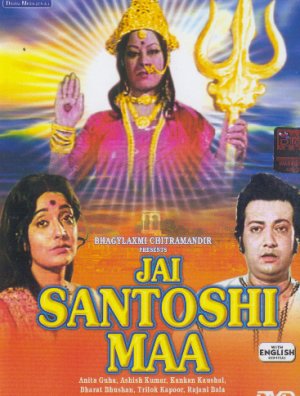
JAI SANTOSHI MAA: Satisfaction


Jai Santoshi Maa
Box art: These are the keeper stills?
You don’t have to be a believer to fall for Jai Santoshi Maa, the low-budget mythological epic that held its own at the box office in 1975 during the reign of Sholay. Anyone who has ever felt like a persecuted underdog can relate to the story. Trapped in a house full of spiteful relations who treat you like a servant? Well, perhaps some personal attention from a magical beyond can convince you that life is pretty good after all. It worked for Harry Potter.

Of course, Harry has tangible evidence of that magical beyond starting at the age of eleven. But Satyawati, our heroine and the true believer of Jai Santoshi Maa, has nothing but her unshakeable faith that the goddess Santoshi will solve her problems if Satyawati worships with sufficient devotion.

You can probably see where this is going. Obviously, in order for Santoshi to reward Satyawati in the most satisfying possible manner, Satyawati must first suffer the slings and arrows of outrageous fortune—the more outrageous the better.

Jai Santoshi Maa takes place simultaneously in heaven among the Hindu gods and on earth in a timeless, filmi version of India. In heaven, Santoshi is the wished-for sister conjured up by Ganesha’s sons; on earth, the motherless Satyawati (Kanan Kaushal) ardently worships the goddess. First Satyawati wishes for a husband, and she falls for the handsome flute-playing Birju (Ashish Kumar) when she meets him once in passing. When he is summoned to play and sing at a temple ceremony honoring Santoshi, she sees that Birju is truly the man for her.


He admires her from afar. But on the way home from the ceremony, Satyawati is jumped by a dreadful dacoit and his leering gang (in a very creepy scene that drives home what life must be like for many a rural Indian girl whose back isn't being omnisciently watched). Birju saves her in the nick of time, and then it’s clear to both of them that they have already spent many lifetimes together.

Bela Bose, Jai Santoshi Maa
Bela Bose is up to something.
In short order Satyawati and Birju are married. Obviously, all can’t continue to go smoothly—if it did, would there be a movie? The troubles come when the other sisters-in-law begin to dump all over both Birju (who wants to play music, not work in the fields) and Satyawati. The leading evil bhabhi is played by the addictively enjoyable Bela Bose, a dancer with a fabulously expressive face who does one of the best sneer-hmmph! combinations I’ve ever seen. (And apparently she had a long career, hooray! Perhaps there is a god after all….) The women laugh at Birju! They want him to earn a living! They feed him… gasp… leftovers!

leftovers, Ashish Kumar, Jai Santoshi Maa
Meanwhile, in heaven, the Big Three goddesses Laxmi, Durga, and Brahmini become jealous of the attention Santoshi is getting from Satyawati. They determine to make Satyawati’s life perfectly miserable and force her to renounce her devotion to Santoshi. To that end, the goddesses ensure that the sisters-in-law drive Birju out of the house (by means of the aforementioned leftovers, which suggests that I’ve been shockingly insulted over and over again since childhood without knowing it), then raise a storm that nearly drowns him as he travels around looking for work, then give him amnesia so that he forgets Satyawati—waiting patiently at home enduring terrible abuse and poverty—and starts to fall for another woman.

You’d think that Santoshi might take up arms against Satywati’s sea of troubles somewhat earlier in the game since the goddess is herself the object of jealousy and derision in heaven. It’s as if the devi and her devotee were new girls in parallel high schools populated by mean girls, and we wait—as in life—for the cruel ones to get their richly deserved comeuppance. But the goddess bides her time, and so things go from bad to worse for her loyal follower. Finally, Satyawati, whose long fasts have given her raccoon eyes like an Edward Gorey flapper, is so downtrodden that she can’t even buy the grams and jaggery necessary for her final Santoshi puja. Santoshi comes to earth in the guise of an old woman (clang! go the cymbals as she is edited abruptly into the scene) and presents weeping, starving Satyawati with the offering.

The film isn’t finished with us yet, even though Birju returns (now rich, having learned the jeweler’s trade and apparently forgotten his wish to be a musician) and Satyawati becomes the luxuriously dressed wife of a prosperous independent household. The mean-goddess triumvirate and the odious bhabhis—now jealous of Satyawati’s good fortune, because it’s always something—are still hoping to get the last word. They get their chance when Satyawati invites everyone to a big celebration in honor of Santoshi. (Check out Bela Bose here, pretending she’s joining in wholeheartedly—but noooo!)


Bela Bose and her henchwoman sneak off and squeeze limes into the food (a no-no for a Santoshi puja, apparently), which causes all the children eating at the festival to drop dead (!!!). The families blame Satyawati—her anger at her mistreatment, they claim, caused her to poison the children of her former tormentors—and things look blacker than ever before in Satyawati’s gloomy life until FINALLY Santoshi puts in a personal appearance, resurrects the dead kids, makes the guilty bhabhis confess, and sets the throng of onlookers cheering her power and her devotee’s spotless perfection. In heaven, the mean goddesses apologize for their misdeeds. All is again right with the world.

Jai Santoshi Maa, It's a Wonderful Life, Jimmy Stewart
Can't get no satisfaction.
How appropriate that Santoshi means “satisfaction.” My goodness, who wouldn’t find it satisfying to see physical proof of the deity’s existence and the smiting of a bunch of baddies all rolled up in one? As when Clarence the bumbling angel saves George Bailey* from his Christmas Eve plunge into the river in Bedford Falls, we root for the heavens to pay attention and the good to be rewarded, however unlikely the prospect seems in the face of so much opposition. Hello, you beautiful old Savings and Loan! Goodbye, Potterville! (Not you, Harry. Different Mr. Potter.)

It’s said that Santoshi was but a minor goddess before this film stormed the box office, but fans (many of them women who presumably found that this story spoke to them in ways that Sholay and Deewaar didn’t) treated the theaters as temples and bowed before the onscreen goddess, which was enough to move her to a more important place in the pantheon. I love when religion bends to the will of humans instead of the other way around.


As Real as the Velveteen Rabbit.
*Or if we’re definitely talking magic and not religion, we might note similarities with another great Jimmy Stewart movie, in which we are exceedingly gratified to learn that Ellwood P. Dowd isn’t just imagining that an invisible giant rabbit has chosen to be his friend. Harvey or Hagrid, Clarence Odbody or Santoshi Maa—I don’t have to believe any of them are real for them to bring me great joy and satisfaction. Ahhh.


Friday, June 29, 2012

LAALCHEE: The Rich Are Different from You and Me


Pran, Laalchee, Lalchee, Rohit RoyLaalchee (“greed”) sounds like a fable. If you search for “laalchee” on Google, as I did, you’ll come up with YouTube videos for this film, and also for several versions of the Aesop-ish Hindi story “Laalchee Kutta” (“The Greedy Dog”). So I was expecting, if not in-depth characterizations, then at least moral clarity.

So who can tell me the moral of this story? Anyone? Anyone?

Is it that being rich means that you can be any damn thing you please, including a leering old lech or a puppetmaster who makes the less wealthy dance for your amusement?

Is it that excesses of money make you treat women like personal playthings, even if they’re not interested in you?

Is it that being rich means that people assume you know what you're doing?

Pran's haveli,
or a reasonable approximation thereof.
Pran is Dinanath, a wheelchair-bound business tycoon living in one of those havelis with an entrance that resembles the driveway at Embassy Suites.

His four younger brothers and four sisters-in-law come to care for the ailing kazillionaire, but he pines for his missing nephew Amar, whose father—another brother—went off in a huff fifteen years earlier, apparently because he didn’t approve of Pran’s shenanigans with the ladies. The brothers and bhabhis surround the lonely invalid with chatter and children, planning picnics and doing what seems like a pretty good job of filling his empty mansion and life. Then along comes the sexy Kamini, a nurse much given to halter tops and short skirts (well is she nicknamed “Mini”). And seeing that she’s sleeping in his room,  that he’s spending ungodly amounts of dough on clothes that consist of little actual cloth, and that he’s dropping broad hints about marriage, the family members begin to worry about whether there will be any inheritance left for them.

Can you really blame them? You don’t have to be motivated by greed to think that perhaps your older brother has…slipped a bit when he’s spending all his time and money on a permed bimbo who pouts and coos and does the sexy-dance [1990s Bollywood version] in the old man’s room at night while the younger brothers spy through the window.


It’s just not dignified. I don’t know what I would do if my big brother began to behave this way*, but I hope I would try to talk some sense into him.

So naturally what the family members do is this: they hire an actor (a well-scrubbed, smiling Rohit Roy) to impersonate the lost and much-missed Amar. And Faux-Amar takes the job and runs with it so effectively that soon Pran is handing him suitcases of money, forgiving and blessing even when the actor is caught red-handed trying to sell the gold chain he swiped from Pran’s bedside table.

I had moments of enjoyment, even moments of surprise, when I thought to myself: How will this character, who I know must be the good guy in the end, overcome our distaste at what is patently not good behavior? Is the filmmaker actually going to create a complex character, a real person with real shades of gray?

Sadly, the answer is no. The key to the metamorphosis is that the scriptwriters (Anil Kalelkar and Anand Vardhan, who seem to have disappeared without a trace) just let the cardboard Good Girlfriend (Karina Grover, but really, who cares)—the one Faux-Amar is saving up to marry—act as a sort of external conscience. She shames the lazy, manipulative, greedy chor into becoming the morally upright boy that his sweet smile and effortless charm have destined him to be. Yawn. And ultimately, Faux-Amar doesn’t have to be a good guy from the get-go; he just has to reach good-guy status before the brothers-and-bhabhis do.

And that turns out to be a ridiculously easy task. Pran reveals that he’s revising his will to give Amar a share, and everyone goes bonkers. Then the scheming Mini, who has been tossed from the house because Faux-Amar noticed that she had a boyfriend on the side, presents a mystery document to Pran. Pran’s lawyer nods grimly and explains that Mini and her beau now control the money, the business, and the Embassy Suites. Yes, just because. Now Pran is penniless! But he can stay with his family, right? No, because then they all line up to tell him that they never liked him anyway and that if there’s no inheritance, then to them he is nothing, nothing!

A much better movie than Laalchee.
Faux-Amar rescues Pran from the sort of old folks’ home where sons won’t even give their institutionalized dads money for a new pair of glasses. (If this entire nursing home weren’t on the ground floor, Munna Bhai would be hanging these guys upside down from windows.) Fortuitously, Faux-Amar has used the suitcase full of money to buy an apartment, and he and the Good-Girlfriend-turned-Dutiful-Wife give it to Pran. Homelessness averted, whew. But suddenly, Mini vamps in and claims the apartment too! Boo, hiss! Nahiiiiiiinn!

Oh, wait—it’s all a ruse. Like Faux-Amar, Mini is also a hireling, brought on board by Pran to prove his suspicions about his family’s greed. You’ll be relieved to know that Pran is still rich. (He doesn’t even need the prop wheelchair any longer.) And Faux-Amar’s reserves of goodness, which once revealed prove to be clear and deep and true, mean that he deserves to end up owning the Suites. And so he does.

Amar before Pran loves him.
What, you thought the Real Amar would appear? Me too. This may be the first time I’ve seen a Lost Son/Divided Brothers story that didn’t end with some kind of reunion. But I credit this to scriptwriter laziness. I think the writers, having invented the Famous Original Amar to serve the plot, then forgot about him once Faux-Amar had discovered that love could turn him as real as the Velveteen Rabbit.

Maybe I should give the screenwriters more credit for their exceptionally apt prediction of the 2012 Republican field. But the inter-familial tribulations of the super-rich were no more interesting in 1997 than they have been since. Let's hope that we don't have to pretend to be the long-lost nephew of a rich guy to start feeling real compassion for one another.


*Which my brother would not; this would strike him as just as much of an affront to his dignity as drinking a can of Bud Lite—and he has informed me that if I ever see him doing that, I should know that he has been kidnapped and is signalling desperately for help.


Thursday, June 21, 2012

ROCKSTAR: Janardhan Strange & Mr. Normal


rockstar, ranbir kapoor, nargis fakhri
Don’t let the title fool you; Rockstar is about neither rock nor stardom. The hero is a musician, and he does become a star, but that is immaterial. Instead, this is a capital-L Love Story. It’s Romeo and Juliet, complete with balcony scene and big finish in Verona. It’s the Punjabi romantic tragedy of Heer and Ranjha (lest you miss that connection, the heroine’s name is Heer). And it’s a fairy tale, one of the darker ones where the fairies are jealous taskmasters, the princess can’t stop dancing, and the happily-ever-after fails to materialize.

And as with any big, sweeping love story, you can jeer or you can let the story wash you away. Maybe it’s just a matter of the mood you’re in when you watch. Plausible? No, not in the slightest. Effective? Well, if you’re up for it, yes.

Love doesn’t sneak up and catch Janardhan (Ranbir Kapoor) unawares. It doesn’t happen gradually, either—instead, he goes looking for it, having heard that its wondrous power will transform him into a better musician. He says that’s what he wants, but he’s young and shallow and doesn’t seem to have strong feelings about much of anything.

Janardhan is like a visitor from another world trying to imitate earthling habits. The other boys at his college call Heer (Nargis Fakhri) a “heartbreaker,” so he watches her intently for a while and then marches off to tell her he’s smitten. Secretly, he hopes she’ll hurt him enough to give him some depth.

She’s beautiful, popular, and engaged to be married. He’s a nobody with a dorky haircut and an awkward posture. He’s persistent, almost stalker-ish, in his pursuit of the broken heart to which the girl is only incidentally attached. And finally she tells him off, so he stops.

And then they rather sweetly become friends. He manages to relax around her and discovers that she’s not the “neat and clean” stereotype he had imagined. Heer awakens, maybe for the first time, some kind of genuine feeling in him—they get to know each other and like what they find. She lists things she wants to do before she gets married, as if marriage is the end of her life. And then she does get married (in what Wikipedia breathlessly tells us is “the first time in Bollywood that a Kashmiri Pandit wedding was shown”), and from there the movie is all about Janardhan—now Jordan—doing his utmost to rescue Heer from that fate.

He becomes a successful musician, travels to Prague (Heer is living there, because Movie Logic)—and then one day he happens on a band of Czech-gypsies-as-imagined-by-Bollywood-filmmakers and finally discovers what kind of a story he’s in:


The lyrics tell of a princess who wears out twelve pairs of shoes in her sleep each night; the young man who seeks to solve the mystery discovers that the wind whirls her off to go dancing. And when I had seen this song, everything suddenly fell into place for me: I now expected not The Doors, but a big, impossible fairy story.

Jordan gets acclaim and vast wealth; Ranbir, descended from Bollywood royalty, looks utterly believable as a rock star*. (The music, from the man known in India as “Oscar winner A.R. Rahman,” works with the swelling emotional peaks of the story, but never remotely resembles rock. Tellingly, at one point Jordan performs before a wowed Euro-crowd so aged and prosperous that it looks like a Kennedy Center command performance.) And Jordan gets the girl. Although Heer’s husband can safely be ignored, apparently being made of the kind of plastic that comes with an unlimited credit line, the lovers find their infidelity searing—she because she's a nice Indian girl, and he because he realizes that he’s the one who whirls Heer off to go dancing night after night.

Lymphosarcoma of the intestines?
It makes him a little crazy, and he attracts paparazzi and a bad-boy rep. But fairyland’s demands on the lady are more stringent, and Heer’s secret makes her mysteriously sick. Doctors confirm that she’s wasting away from a filmi disease. She is dying—but when Jordan touches her, she revives. If only he could hang on forever! But he has to perform (he is constantly threatened with arrest for failing to show up for contractually obligated concerts, as if Ticketmaster ran the world). When the police come to drag Jordan from Heer’s hospital bed, he admits to his mentor—the man who told him that great artists need pain—that he would gladly give up his broken heart and all that it has brought.

And yes, snark-worthy as the plot is, I was totally buying it at this point. Ranbir is a very fine actor, Nargis Fakhri is lovely, and together they make sparks fly. Maybe it's soapy, but it's also operatic--and I know that if the dancing lady spends too much time in Fairyland, of course she must die. [Spoiler alert: Juliet and Heer don’t fare so well themselves.]

Heer and Jordan,
an artist's interpretation
But then… what? I confess that I'm still not certain of Jordan’s fate. He’s performing in Verona when an apparition of Heer walks toward him to say farewell, and the film just… ends. There’s an onscreen scribble about the lovers being together in the fields of forever someday that is Karan Johar-esque (or Jack Handey-esque, depending on the depths of your resistance to this sort of thing). What? No, I want specifics. In fact, I felt a little cheated that director Imtiaz Ali didn’t give me a full-on Romeo/Ranjha moment of Jordan racing heedlessly toward death because his beloved is gone.

But I guess the Gentleman with Thistledown Hair, soulless though he may be, has the consolation of knowing that the lady will twirl with him in the fairy ballroom through all eternity.


*Nobody asked me, but rock star is two words. Just sayin'.

Tuesday, June 19, 2012

WAISA BHI HOTA HAI: Getting Involved


waisa bhi hota hai, arshad warsi, prasanth narayanan, pratima kazmi
Waisa Bhi Hota Hai has a lot going for it, like very assured performances, a solid script, and credits that thank “Q. Tarantino, E. Coen, J. Coen,” and other indie heroes. It’s smart and funny, and--as you’d expect with inspiration like that--dotted with bursts of pretty savage violence.

Arshad Warsi--who first played Munna Bhai’s underling Circuit in Munna Bhai MBBS the same year, 2003--is Punit Sanyal, the creative director of an advertising company who hates his job and his boss. He flirts with his coworker Sumi, but he’s living with a cute policewoman named Agni (Sandhya Mrinal). In truth, both our hero and writer/director Shashanka Ghosh seem more interested in the idea of a copywriter who loves a policewoman than in the actual relationship between Punit and Agni, and she proves to be not much more than kohl-wearing, pixie-haired machinery to move the plot along—but I cut Shashanka Ghosh some slack for the one great female role he has given us, a bloodthirsty yet matriarchal don named Ganga (Pratima Kazmi) whose aim is to take over the Mumbai underworld.

But we’ll get to her in a minute. First, Agni gets the story going by throwing Punit out (because, um, he didn’t tell her about his estranged brother? Or something. Whatever…). He’s drunk on a bench somewhere when a gang of shooters opens fire on Vishnu (Prasanth Narayanan). Vishnu crawls over to die near the bench, not seeing its occupant, and Punit gets up to sneak away unnoticed. But Vishnu opens his eyes and gives the copywriter the same advice Punit has just been giving himself: Get out of here! Don’t get involved! And then Punit can’t stop himself. He must save the gangster, who in exchange offers Punit a very swell Mumbai flat and, eventually, his friendship and trust.

pratima kazmi
Give Ganga your oongli like a good goonda.
Vishnu is the hired killer for Ganpat, the boss of Mumbai and the man that Ganga is desperate to unseat. Neither don is the sharpest knife in the drawer (heh--Ganga loves to tell her gang stories of Japanese gangsters who, in shame over a failure, cut off a finger as a gift for their boss, and she makes her boys play the same game).  But both are absolute in their commitment to killing anyone who gets in their way, and the bodies pile up.

Prasanth Narayanan
Prasanth shows us his gun.
It doesn’t take Punit long to be dragged into Vishnu’s activities. The copywriter professes to admire the shooter and his colleagues, comparing them to bankers who have the same cold way of bringing about someone else’s ruin without feeling strongly about it. (Tell us about it, advertising man.) And Vishnu is, as gangsters go, a handsome, smart, decent, old-fashioned fellow who is never more flustered than when Punit’s sexy colleague Suni asks him for his number. He’s so old-fashioned that he only goes to one brothel, where he always sees the same woman, who gives him the same advice Punit begins to give: Get out of the business! Don't get involved!

There’s more, much more. Let’s see: Punit’s estranged brother (remember him?) was a gangster  who informed on Ganpat and was therefore killed by Vishnu; everyone finds out this crucial piece of information before Punit knows it, so Vishnu is sent to kill Punit, and another shooter is sent to make sure Vishnu follows through, and Punit and Vishnu meet on the beach where singer Kailash Kher, appearing as himself, sings this terrific song:


And then Kailash gets shot dead (hey, it’s fiction! he's FINE!) and Punit gets kidnapped by Ganga’s dopey but deadly boys because she thinks he’s suckering Vishnu into friendship so he can get revenge, and Punit tries to escape and warn Vishnu by pretending that he has to give a speech, which he gives in English so Ganga and the boys won’t understand. Ha! Oh, and Agni rounds up Ganga’s gang and humiliates her during the perp walk, which makes us hate Agni just a bit even though we know that Ganga is really not a nice person at all. And from there the story becomes complicated....

Soon enough most of these characters are dead, and the rest are getting an appropriate comeuppance (good or bad, more or less as is their karmic due), some at the hands of a group of Sikh rappers. I won’t say any more; I’ve already told you too much.

I had no idea films with this kind of street-smart indie cred were being made in Mumbai all the way back in 2003. (OK, realistic savage violence was already happening, thanks to my close personal friend the director Ram Gopal Varma* and my boon companion the screenwriter Anurag Kashyap, who together gave us Satya in 1998, but face it, that wasn’t really very funny.) Waisa Bhi Hota Hai may not hang together perfectly--in fact, I didn't much care whether Agni ended up happy or dead, and I suppose that's a problem--but the core relationship between Punit and Vishnu has real emotional resonance, the bad guys aren't just pretending, and Ganga? Ganga is totally rocking, yaar! If she wanted me to cut off my finger, why, I would launch into the most affecting speech you ever heard. In English.


Mike Enright photo
Red-faced and sweaty: good look for me?
*No, really, I did actually meet RGV once. (Photo by Mike Enright.) He asked me what Hindi film I had seen most recently, and I answered (truthfully) Salaam-e-Ishq. When he asked what I thought of it, I told him that I liked Govinda in it. As the words crossed my lips, I knew that I was totally blowing any chance that he could ever respect me. Now I can admit to myself that sometimes Salman is phoning it in and that big Indian musicals can be every bit as crappy as films from everywhere else. But at the time I was still in thrall to ***Bollywood*** the way the French love Jerry Lewis and the Germans love David Hasselhoff. Oh, well--RGV himself hasn’t proved to be infallible; we were on the set of Ram Gopal Varma ki Aag at the time….

Sunday, June 3, 2012

BAABUL: The Family Jewels

Baabul wants so badly to be an old-school Bollywood masala entertainment that I really tried to like it. There’s Amitabh Bachchan as the happiest of men (until The Tragedy strikes)—he has a mansion, a son (Salman Khan) who is both his “buddy” and the heir to his jewelry empire, and a wife (Hema Malini) who’s still beautiful and coquettish and, being Hema, a great dancer. There’s throaty-voiced Rani Mukherjee, one of my favorite current heroines. There’s a good song written and sung by the Big B himself playing over the opening credits. What could go wrong?

Salman Khan in his pre-gymnified youth
Oh, so many, many things. But let’s cut to the chase. I know Salman Khan still has legions of fans, and I haven’t always found him off-putting—I confess, I thought he was quite charming in his pre-gymnified youth (maybe it’s just that I saw Hum Aapke Hain Kaun when I was new to Bollywood and willing to suspend more disbelief than I can these days). Now, he’s the same in every movie—puffy-eyed and glib, phoning in every scene like a musclebound Dean Martin.

Monday, May 28, 2012

3: 1 Charming Love Story + 2 Totally Disparate Halves

Dhanush
Dhanush
The U.S. premiere of the Tamil film 3, directed by Aishwarya Rajnikanth Dhanush and starring her husband, film star (and surprise pop star) Dhanush, happened on Saturday afternoon as part of the New York Indian Film Festival. I didn't even know enough about Tamil films to know that Dhanush was a big deal. When I saw Shahrukh Khan poking fun at "Kolaveri Di" in this video, I thought he was being a little harsh (as is so often SRK's wont). What kind of threat is Dhanush to Superstar SRK? Why this kolaveri di from King Khan?

Well, as it turns out, I think Shahrukh is right to be feeling a bit bothered by the competition. Because guess what—Dhanush is a terrific dancer, an adorable lovelorn hero, and very, very young.

The film is a bit of a mess. By the time we get to the picturization of "Kolaveri Di," 3 has already begun to rocket off the rails and become the Indian equivalent of a disease-of-the-week movie, aiming to raise our awareness of the scourge of bipolar disorder with appearances from a psychiatrist (who seems deeply misguided both about how bipolar disorders manifest and about how to treat them) and long periods of earnest exposition from the hero's bosom friend (who barely registers before the interval but afterward is privy to information that the hero can't reveal even to the wife who is his soul mate).

But you know what? The first half was so good I almost didn't mind. Our hero Ram (Dhanush) falls for the heroine (Shruti Hassan) and woos her by following her to after-school tutoring. He's so in love that he beams uncontrollably even when she isn't around--and Dhanush's smile is so beatific that it's hard to believe it takes her weeks to return his fond look. When she finally does smile at him, we get a moment that made me remember why I loved Indian films in the first place: the young couple's joy is so boundless that it can be conveyed only in a song. And I can't recall a purer expression of happiness than the picturization of "Idhazhin Oram." Monsoon rains drench, the heroine and her little sister dance on the rooftop, and Dhanush struts in the street and tangoes down the school corridor with abandon. A cool breeze ruffles the hair of sweaty students, neighbors celebrate a holiday with sparklers, and the whole world is briefly perfect.

Too bad that we then have to sit through the post-wedding half of the film as the hero grows increasingly shaggy facial hair and behaves ever more erratically (call it the Raja Hindustani effect). And without an evil stepmother to vanquish, since the demons this time are within, Ram can only lash out at those he loves—and finally himself. Sigh.

Here's the delightful point where I wish the filmmaker had left the happy pair. Go ahead, watch it. I dare you not to smile!


(If you are not one of the 56 million people who has already watched the official YouTube video of Dhanush singing his soup song, you can do so here.)